Opinion
For decades, the global story about African football at the World Cup followed a predictable script: spirited underdogs, flashes of brilliance, heartbreaking exits, and the familiar refrain of “potential.” Africa was the continent of ‘almosts’: almost breaking through, almost upsetting giants, almost rewriting the hierarchy of world football.
That narrative is collapsing while the 2026 World Cup is still unfolding. “The 2026 World Cup has forced the world to confront a new reality: Africa is no longer participating in the global football story Africa is shaping it. The shift is not symbolic. It is structural, cultural, competitive, and irreversible”.
A New Era of Presence: Ten Flags, One Continent
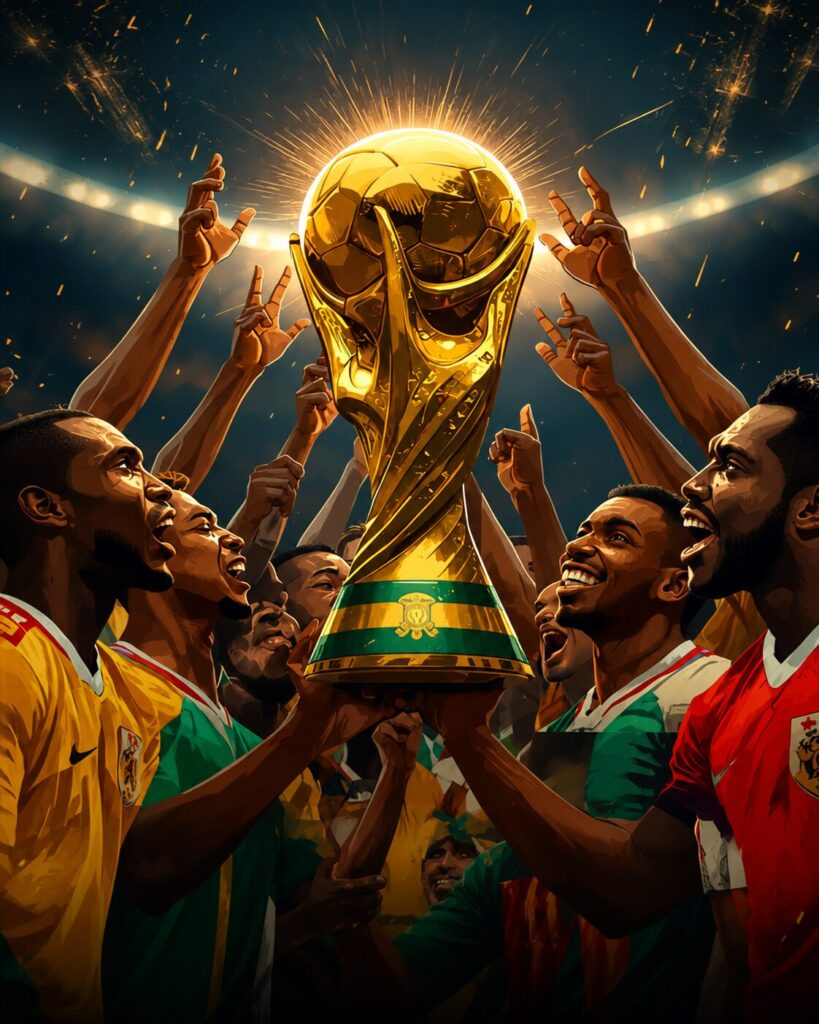
For the first time in history, Africa arrived at the World Cup with ten nations, a scale of representation that instantly changed the emotional and political weight of the tournament. Ten flags meant ten stories, ten styles of play, ten cultural identities and a unified continental presence that could not be sidelined or patronized. This expansion did more than increase numbers. It expanded imagination. Africa was no longer framed as a guest in football’s global house. It was a co-author of the event’s atmosphere, drama, and meaning.
Performance Has Rewritten the Script
The old narrative that African teams were unpredictable, inconsistent, or naïve collapsed under the weight of actual results.
- Morocco holding Brazil with tactical maturity
- Cape Verde drawing Spain with composure and clarity
- Ivory Coast defeating Ecuador with late-game discipline
- Ghana winning with confidence, not desperation
These were not “miracles.” They were manifestations of footballing maturity.
African teams are no longer defined by emotion or flair alone. They are defined by structure, coaching evolution, diaspora integration, and a hardened competitive mentality. The world is being forced to recalibrate its expectations.
Cultural Power: Africa as a Global Storytelling Force
The World Cup is not just a sporting event. It is a global storytelling machine. And Africa has mastered the art of cultural authorship. In the stands, African fans have become the heartbeat of the tournament; drums, kente, boubous, beads, flags, painted faces, and choreography that turns stadiums into cultural theatres. This is not entertainment. It is soft power. On social media, African creators, commentators, and diaspora communities have amplified narratives that once lived only on the continent. The world is not just watching African football. It is watching African identity. This is the first World Cup where Africa’s cultural presence is not treated as exotic color. It is treated as central energy.
The Diaspora Effect: A Global African Team
The African story at the World Cup is no longer confined to the continent. It is transnational, carried by millions whose identities stretch across Lagos and London, Accra and Amsterdam, Dakar and DC. The diaspora has become one of Africa’s most powerful narrative engines – not because it replaces the continent, but because it amplifies it. What used to be framed as “dual nationality debates” is now understood as a global African talent ecosystem. Players born in Paris, Brussels, Toronto, or Berlin are not outsiders. They are part of a long, living continuum of African identity, one that moves, adapts, and returns home in new forms. This is not dilution. It is expansion. The diaspora has given African teams:
- elite training environments
- exposure to high-pressure football cultures
- tactical diversity and positional depth
- a global fan base that travels, posts, streams, and advocates
And in return, African teams have given the diaspora something priceless: a place to belong on the world’s biggest stage. The diaspora is not a backup plan. It is a vote of confidence.
Soft Power and Tourism: How Football Rebrands Nations
The World Cup is the single most powerful storytelling platform on the planet. For one month, billions of people watch, search, post, and emotionally invest in countries they may never have thought about before. And in 2026, African nations have used this stage not just to compete – but to rebrand themselves. Football has become a form of national diplomacy, a soft-power engine that shapes how the world imagines a place. When Cape Verde holds Spain, or Morocco frustrates Brazil, or Ivory Coast scores a late winner, something subtle but powerful happens: the world becomes curious.
People search:
- “Where is Cape Verde?”
- “Travel to Abidjan”
- “Morocco tourism 2026”
- “Accra nightlife”
A football moment becomes a gateway to cultural discovery.
Africa is no longer being introduced to the world through poverty-based charity campaigns or wildlife documentaries. It is being introduced through joy, excellence, and national pride.
The 1966 Boycott: Africa’s First Football Revolution
Africa’s modern football power did not begin on the pitch. It began with a political act of collective defiance. In 1964, FIFA announced that Africa, Asia, and Oceania would share one single World Cup slot, while Europe received ten and South America four. It was not just unfair. It was insulting. So between 1964 and 1966, all 15 African nations in the Confederation of African Football (CAF) made a historic decision: they unanimously withdrew from the World Cup qualifiers. Their message was simple:
If Africa is not valued, Africa will not participate.
The boycott took full effect in 1965, leaving the 1966 World Cup with zero African teams. FIFA, under global pressure and facing the embarrassment of an entire continent withdrawing, finally conceded. Starting in 1970, Africa was granted its own guaranteed World Cup slot for the first time. This was not a concession but a glorious victory earned through collective resistance. This boycott was Africa’s first declaration of football sovereignty establishing the principle that still shapes 2026: Africa will not accept a narrative written for it. Africa writes its own.
The Psychological Shift: Africa Competes as an Equal
For decades, African teams entered the World Cup carrying an invisible weight… the burden of proving they belonged. Every match felt like a test. Every mistake felt like confirmation of a stereotype. Every victory was framed as a “shock,” a “miracle,” or a “fairytale.” That era is over. African teams now step onto the pitch with the psychology of equals, not guests. You can see it in the calmness in possession, the tactical discipline, the refusal to panic under pressure. This is not the football of a continent seeking validation. This is the football of a continent that knows its value. Respect is no longer requested, it is assumed. The old narrative praised African teams for “bravery” or “spirit.” The new narrative recognizes shape, structure, game management, and tactical intelligence. African football is finally being discussed in the same vocabulary as European and South American football. The psychological gap is rapidly closing as the world adjusts.
From Milla to Today: The Continuum of African Legacy
African football has always produced moments that shook the world – Roger Milla dancing in 1990, Nigeria’s golden generation in 1994, Senegal’s shock victory in 2002, Ghana’s near-semifinal in 2010, Morocco’s historic run in 2022. But for decades, these moments were treated as anomalies. The 2026 World Cup reframes them as infrastructure, Milla’s dance. Okocha’s flair. Eto’o’s leadership. Drogba’s power. Gyan’s goals. Hakimi’s fearlessness.
These are not memories but building blocks. Today’s African teams are not starting from scratch. They are standing on the shoulders of giants and reaching higher. Africa’s football story is no longer episodic. It is continuous, cumulative, and intentional.
Africa Is Not Changing the Narrative because Africa Is the Narrative
For the first time in World Cup history, Africa is not fighting for visibility, legitimacy, or respect. Africa is not asking to be included in the global football conversation. Africa is the conversation and the tournament has just begun. The continent’s presence in 2026 has revealed a truth that was always there, waiting for the world to catch up:
African football is not an underdog story. It is a story of identity, continuity, and global influence.
- Africa has moved beyond potential into presence.
- Beyond surprise into structure.
- Beyond emotion into strategy and authorship.
The world is not witnessing the beginning of Africa’s football story.
The world is witnessing the moment Africa finally seized control of its own narrative… culturally, competitively, and globally. Africa is not rising. Africa is arriving. And the World Cup will never look the same again.